Ever noticed how people sometimes rave about a company more after something goes wrong, so long as it’s handled well? It’s a quirk of human psychology called the service recovery paradox, the idea that customers who experience a problem (and see it resolved brilliantly) often become more loyal than if nothing had gone wrong in the first place.
In 2018, KFC did the unthinkable. A chicken restaurant ran out of chicken. Thanks to a botched logistics switch, supply chain chaos left hundreds of KFC outlets across the UK without their key ingredient. The headlines wrote themselves, customers got angry, and social media went bananas.
Most brands in this situation would have panicked, blaming suppliers, issuing generic corporate apologies, or worse, going silent and hoping it would blow over. But not KFC. They turned the disaster into a textbook example of crisis management done right.
Own the problem
Instead of corporate jargon or legalese, KFC responded with their on-brand humour, humility, and straight-up honesty. The didn’t hide. Their now-iconic “FCK” ad (rearranging their own logo to reflect how they really felt) was simple, self-aware, and perfectly in tune with the brand’s tone of voice. It ran as a full-page ad in major newspapers, acknowledging the mistake and apologising to customers without sounding defensive or robotic, injecting humour to defuse the situation.
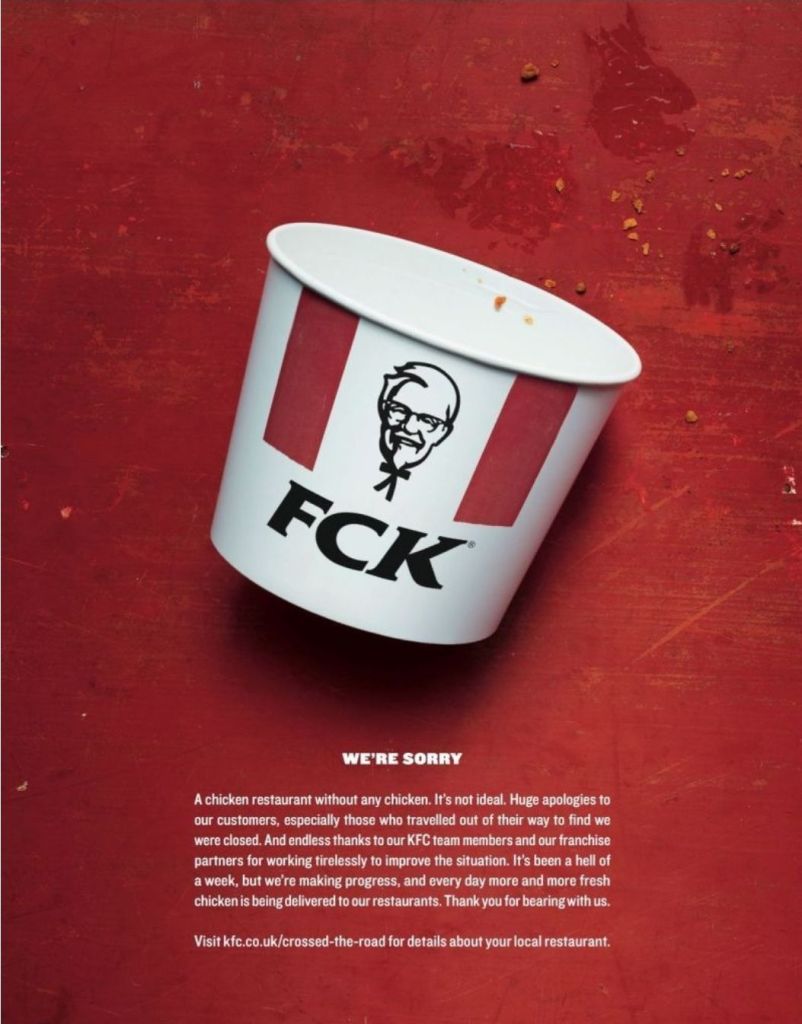
Communicate early and often
KFC didn’t wait for the media storm to dictate the narrative. They knew that transparency builds trust. They were proactive in updating customers through social media and explaining what was happening. Instead of letting frustration build in silence, they kept customers informed, even when the news wasn’t good.
Stay on brand (Even in a crisis)
KFC’s marketing is known for being cheeky and irreverent, and they didn’t abandon that in a crisis. The “FCK” ad, the playful tweets, and the self-deprecating tone all stayed true to their identity. They didn’t suddenly become a stiff, corporate entity just because they were in trouble. I’d argue that their distinct tone of voice was a key asset in damage control.
Turn customers into advocates
Instead of going into full-on defence mode, KFC leaned into the absurdity of being thr chicken restaurant without chicken. Customer and the press were talking about them no matter what, but KFC was able to guide the conversation. They reshared funny tweets, engaged with frustrated fans and let their audience be part of the conversation. By embracing the humour in the chaos, they diffused much of the anger and turned potential PR disaster into a brand-building moment.
Fix it and move on
After the initial response, KFC didn’t drag out the drama. Solutions and action matters more than apologies. They focused on fixing the problem, communicated when stores were reopening, and got back to business. No excuses, no overexplaining—just action.
Most brands dread PR disasters, but KFC proved that when handled well, a crisis can actually enhance brand perception.
 Daniel Fox
Leave a comment