I want to be clear from the start: I’m not anti-AI. Quite the opposite. I use AI a lot, both at work and at home. I work for an AI software company and regularly talk about the benefits of AI. It’s useful for plenty of things, including generating content and creative assets.
But using AI a lot also means paying attention to where it helps, where it falls short and what we still need to bring to the process ourselves.
The danger of using AI for creative thinking is not that it can’t produce ideas. It can produce them very quickly. The danger is that the ideas can start to feel familiar before we’ve noticed how familiar they are.
We’ve started calling it “AI slop”: a flood of content that looks finished, sounds plausible and says very little that feels new. Alongside that is the sameness. Give AI a brief and it can return something polished and competent, but often with a quality that feels as if we’ve seen it before.
I’ve been thinking about this a lot, so I decided to run a small experiment.
I chose five well-known brands: Volkswagen, Budweiser, L’Oréal, Lloyds Bank and IBM. They operate in different categories, sell different things and speak to different audiences. I gave each brand a simple advertising brief in a separate prompt, with no system memory or shared information between them.
Then I looked at the results at each stage, before reiterating.
What I found was more worrying than I expected: the ads were alarmingly similar to one another. Different brands, different products, different audiences, but the work kept converging on a similar kind of answer.
First, just make an ad
My first prompt was:
“Create an image of an Ad for <Brand>, using none of the iconography of other previous ad campaigns, other than the logo”
The instruction was to create an ad for IBM without leaning on familiar campaign imagery, apart from the logo – after all, I want the tool to bring the creativity. Each brand had its own simple brief, but the same pattern emerged: despite the differences between them, the initial results felt strikingly alike.
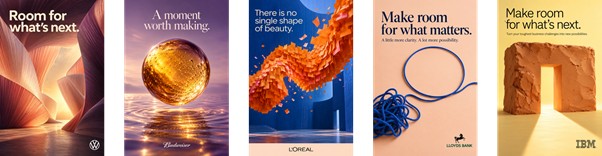
Similar imagery, fonts, and layouts supporting generic and uninspiring headlines.
That’s a worry, because the brands themselves should already give the AI very different creative starting points. A car brand, a beer brand, a beauty brand, a bank and a technology company have different products, customers and reasons to advertise. Yet the outputs didn’t feel as distinct as those differences should lead us to expect.
The AI had made an ad for each brand. But didn’t find a distinct idea for a single one.
Then, consider the audience
The second prompt was:
“Now consider the target audience, and create another image with this audience in mind.”
This is a sensible step. Advertising should be made for someone, not just for a brand. But the experiment revealed another striking pattern: even when the audience was brought into the brief, the results across the five brands still felt alarmingly similar.
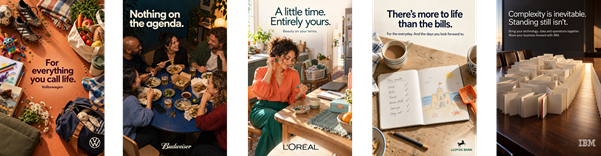
The audience matters, of course. A person considering a car is in a different frame of mind from someone choosing a bank, buying beauty products or evaluating business technology. You can tell that the AI is considering the audience. You could argue the image showing the clutter of the life of a Volkswagon driver is insightful. It’s captured a nice carefree feel in the Budweiser ad, and I like the headline “There’s more to life than the bills” suggested for the bank advert. But putting them side-by-side shows that simply telling AI to “consider the target audience” didn’t appear to create enough separation between the answers.
The L’Oreal headline stood out to me for the wrong reasons. Framing around having time to oneself doesn’t feel like the essence of why people buy L’Oreal products, and the imagery stood for absolutely nothing. It’s a reminder that naming an audience isn’t the same as understanding them. A useful brief needs to get into what that person wants, what they believe, what they worry about and what might make them act. Without that depth, “the audience” can become another generic tick-box (or in this case, a prompt) rather than a source of a genuinely different idea.
Then, show the product
The third prompt was:
“Create another image of an ad for <brand>, this time showing the product”
This changes the emphasis again. The AI is now being asked to make the product more central. And yet, when I compared the results at this stage across all five brands, the same issue remained: the output for one brand still felt too close in spirit to the output for another.
The brands and products were different. The audience was different. The instruction had changed. But the work kept drawing towards a similar creative territory.
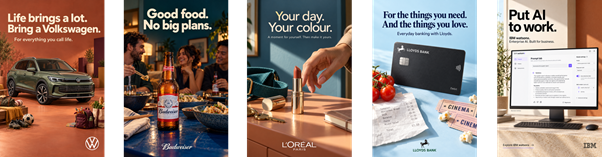
Of all the ads, the Volkswagon, Lloyds Bank and IBM ones could perhaps pass for something acceptable… but they all feel a little bit “meh”.
That is the sameness I wanted to examine. It isn’t necessarily that every image is identical. It’s that the work can share a familiar feel, even when the brief gives us the opportunity to expect distinctiveness.
The brief still matters.
This isn’t an argument against using AI to create. I use it because it can be incredibly helpful. It can quickly mock-up ideas, generate assets, speed up exploration and give us something tangible to react to. It can help turn a thought into a first draft, or a rough idea into something we can assess and improve.
But generating an output is not the same as providing the creative thinking behind it.
Admittedly, the prompts I supplied were deliberately short, vague and lacking any creative or commercial direction. But that’s my point. The brief, the audience insight, the decision about what the brand should say and the distinctive idea that makes the work memorable still need to come from us.
That is especially important when we are working with brands that need to stand apart. If five very different brands produce work that feels alike, it’s a reminder to look closely at what we’re asking the AI to do, and what we’re bringing to the process ourselves.
AI can help us make the ad, the human still has to make sure it could only belong to that brand.


Leave a Reply